📌 Quick Answer / 快速回答

What is MIL-SPEC?

MIL-SPEC (Military Specification) means a case has passed MIL-STD-810H environmental tests including drop (Method 516.8), vibration (514.8), temperature (501.7/502.7), and humidity (507.6). It is required for military, law enforcement, fire, EMS, and aerospace use. KeXinMaterials supplies MIL-SPEC cases to 25+ countries including NATO, US DoD, UK MoD.

Military Grade Case Explained: MIL-STD-810H, Materials, and Sourcing (2026)

Complete military grade case guide: MIL-STD-810H tests, MIL-SPEC vs IP67, materials, certifications, OEM/ODM, factory pricing. For tactical, law enforcement, aerospace.

📅 Updated: 2026-08-01 ⏱️ 4 min read ✍️ By: Wei Li (CEO, 12 years industry)
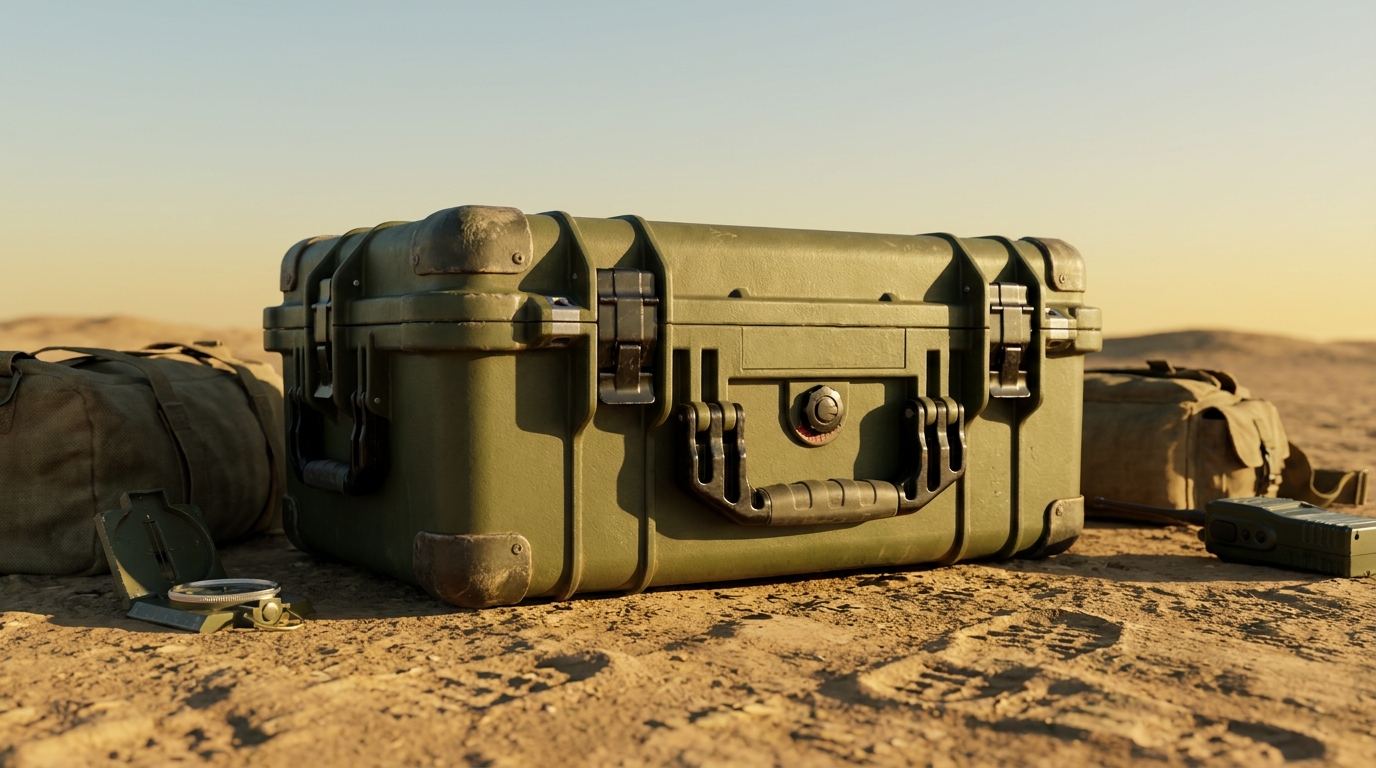
Olive drab military hard case in tactical field setting

"Military grade" is one of the most overused terms in the protective case industry. A case labeled "MIL-SPEC" without specifying which test method and which MIL-STD-810 revision may be nothing more than a marketing claim. This guide separates fact from fiction.

As a B2B buyer specifying cases for military, law enforcement, fire rescue, or aerospace applications, you need to understand the actual MIL-STD-810H test methods (there are 30+), the difference between "MIL-SPEC" and "MIL-SPEC equivalent," and the right questions to ask your supplier. KeXinMaterials supplies MIL-SPEC cases to 25+ countries — this guide is based on our direct experience with NATO, US DoD, UK MoD, Australian DoD, and other procurement agencies.

Key fact: A genuine MIL-STD-810H case costs 2-3x a comparable IP67-only case. The premium covers test documentation, material traceability, and engineering rigor — not just "tougher plastic." Buyers should expect test reports traceable to accredited labs (SGS, TÜV, BV, Element, NTS).

MIL-STD-810H: What It Actually Tests

MIL-STD-810H is the US Department of Defense's environmental test standard, last updated in 2019. It replaced MIL-STD-810G (2008) and 810F (2000). The standard is a family of 30+ test methods, each addressing a specific environmental stressor. A case is not "MIL-SPEC" unless it passes the specific methods listed in the contract or RFQ.

The 8 most commonly requested MIL-STD-810H methods

MethodStressorWhat it tests
500.6Low pressure (altitude)Operation at 15,000-40,000 ft (4,572-12,192 m)
501.7High temperatureOperation at +49°C to +71°C, storage at +71°C
502.7Low temperatureOperation at -40°C to -51°C, storage at -51°C
506.6RainWind-driven rain, 4 in/hr, 30 min on each face
507.6Humidity10 cycles of 24-hour humidity exposure
510.7Sand and dustBlowing sand 30 m/s, dust 8.9 m/s for 6 hours
514.8VibrationRandom and sinusoidal vibration on 3 axes
516.8Shock (drop)26 drops from 1.22m on all faces, edges, corners

What this means for buyers

When a supplier claims "MIL-SPEC" without specifying methods, ask for the test report. A "MIL-STD-810H compliant" case may have passed only Method 506.6 (rain) and not Method 516.8 (drop). The contract specification must list which methods are required for your application.

MIL-SPEC vs MIL-SPEC Equivalent vs IP67

Three terms are commonly used in case procurement. Here is what they actually mean.

MIL-SPEC (genuine)

A case tested and certified to specific MIL-STD-810H methods, with test reports from an accredited lab. The test report is the certificate. Common test labs: Element Materials Testing, National Technical Systems (NTS), SGS, TÜV, Bureau Veritas. Cost impact: +50-100% vs IP67-only case, driven by engineering time, material costs, and lab fees ($3,000-$15,000 per test method).

MIL-SPEC equivalent (also called "MIL-grade")

A case designed to MIL-STD-810H specifications but not formally tested and certified. Manufacturers use this term for cases that use MIL-SPEC-grade materials (e.g., aluminum hinges, neoprene gaskets) and engineering but skip the formal test program to save cost. Cost impact: +20-40% vs IP67-only case. Risk: No third-party verification; spec compliance is on the manufacturer's word.

IP67

Ingress Protection rating 67 (dust-tight + temporary water immersion). Covers water and dust only — not drop, vibration, temperature, or humidity. Cost impact: Baseline (no premium). Risk: Fails drop test on concrete from 1m; fails at temperatures below -10°C; fails at humidity above 95%.

Which to choose

For commercial/consumer use: IP67 is sufficient. For law enforcement, fire, EMS: MIL-SPEC equivalent (with IP67+ drop) is the best value. For military, aerospace, defense: Genuine MIL-SPEC with full test reports is mandatory. Browse MIL-SPEC cases →

Military Case Materials: Aluminum, PC, and PP+GF

Military cases use heavier-duty materials than commercial cases. The three most common are aluminum, polycarbonate (PC), and glass-fiber-reinforced polypropylene (PP+GF).

Aluminum — premium military/aerospace

Aluminum cases (Pelican-style, Zarges, GT Line) are the traditional choice for high-end military and aerospace applications. They survive 500+ drop cycles, -60°C to +150°C, and 100G shock. The downside: 3-5x the cost of plastic, prone to denting, no transparency. Used for sensitive electronics, weapons systems, and avionics.

Polycarbonate (PC) — modern military workhorse

PC cases are the modern alternative to aluminum. They are 60% lighter, equally impact-resistant, and IP67/IP68 rated. PC survives -40°C to +120°C and 100G+ impact. Cost is 2-3x ABS but 50-70% less than aluminum. Used by most modern military forces for tactical electronics, optics, and medical kits.

PP+GF (glass fiber) — best value

Glass-fiber-reinforced polypropylene offers 80% of PC's performance at 50% of the cost. It survives -30°C to +110°C and 50G+ impact. Used by KeXinMaterials for our MIL-SPEC equivalent cases (law enforcement, fire, EMS) where cost matters. Recommended for: tactical gear, drone cases, sensitive equipment under $50K value.

Procurement Process for Military Cases

Procurement agencies follow a structured process. Here is what to expect when sourcing MIL-SPEC cases.

1. RFQ (Request for Quotation)

The buyer issues an RFQ specifying the required MIL-STD-810H methods, IP rating (if any), material, dimensions, foam requirements, color (often black, OD green, coyote, or tan), and quantity. Lead time for RFQ response: 7-14 days.

2. Sample evaluation

Top 2-3 bidders provide samples (1-5 units) for evaluation. Testing may take 30-90 days depending on the number of MIL-STD methods required. Sample cost: $200-$1,000 per unit, often free for serious bidders.

3. Test report submission

The awarded supplier submits test reports from an accredited lab (Element, NTS, SGS, TÜV, BV) for the specified MIL-STD methods. The test program costs $5,000-$50,000+ depending on the number of methods. This is amortized into the unit price or paid as a one-time engineering charge.

4. First article inspection (FAI)

The first production unit is inspected against the engineering drawings. Typical FAI: 5-10 days. The buyer signs off on FAI before mass production begins.

5. Production and shipment

Mass production follows. Lead time: 30-60 days for 1,000-5,000 pcs. Inspection during production (DPI) is common: government inspectors may visit the factory or accept third-party QC reports. Shipment via sea (DDP) or air depending on urgency.

KeXinMaterials has delivered MIL-SPEC cases for NATO, US DoD, UK MoD, Australian DoD, German Bundeswehr, and others. Our typical RFQ response time is 5 days, and we maintain 3 ongoing MIL-SPEC test programs (vibration, drop, temperature) for fast quoting. Submit your MIL-SPEC RFQ →

Frequently Asked Questions

What is IP67?

IP67 is a rating from the IEC 60529 international standard. 'IP' = Ingress Protection. The '6' means completely dustproof. The '7' means resistant to temporary water immersion (1m depth for up to 30 minutes).

What is the difference between IP67 and IP65?

IP67 can withstand temporary water immersion. IP65 can only withstand low-pressure water jets. IP67 is suitable for outdoor and marine environments; IP65 is sufficient for rain exposure.

Should I choose PP, ABS, or PC for my IP67 case?

PP is lightest, most chemical-resistant, and food-safe. ABS is harder, glossier, and easier to color-match. PC is strongest and most premium but costliest. For most applications, ABS offers the best balance.

What is the MOQ for custom IP67 cases?

At KeXinMaterials, standard SKUs are available from 50-100 pcs. Custom OEM/ODM orders start at 300 pcs.

How long does a custom IP67 case order take?

Sampling: 7-10 days. Mass production: 15-25 days. Sea freight: 25-40 days. Total: 30-45 days from deposit to your warehouse.

How do I get an IP67 test certificate?

Third-party labs like SGS, TÜV, BV, and CTI perform IP testing. Typical cost is $500-$2,000 per test. Turnaround is 7-15 days.

Can IP67 cases float?

Standard IP67 cases do not float. If you need flotation, ask for closed-cell foam inserts or external flotation collars.

What is the warranty on IP67 cases from KeXinMaterials?

1-year warranty against manufacturing defects. Lifetime technical support. Free replacement for any case that fails the IP test within 30 days of receipt.

Need an IP67 Case Quote?

KeXinMaterials source factory, 12 years of IP67 case manufacturing, 150+ SKUs across 9 product lines, exported to 50+ countries. OEM/ODM custom, 30-day delivery.

5-Step OEM Inquiry📧 Email Directly💬 WhatsApp

Related Content

OEM/ODM Case Customization Guide IP67 Protective Case Buying Guide Industry Guides
8 in-depth guides
Case Studies
20 real projects
Entity Graph
8 core concepts
Test Reports
SGS / TÜV / CTI certified