📌 Quick Answer / 快速回答

What is IP67?

IP67 is an ingress protection rating per IEC 60529. The 6 = completely dustproof, the 7 = protected against temporary water immersion (1m depth for 30 minutes). It is the most common rating for industrial, military, and outdoor protective cases. To learn more, see our full IP67 buying guide with material comparison and OEM pricing.

IP67 Protective Case Buying Guide: Specs, Materials, OEM & Pricing (2026)

Complete IP67 protective case buying guide: IEC 60529 rating, material comparison (PP/ABS/PC), use cases, OEM/ODM, source factory pricing. 2,500+ words.

📅 Updated: 2026-08-01 ⏱️ 6 min read ✍️ By: Wei Li (CEO, 12 years industry)
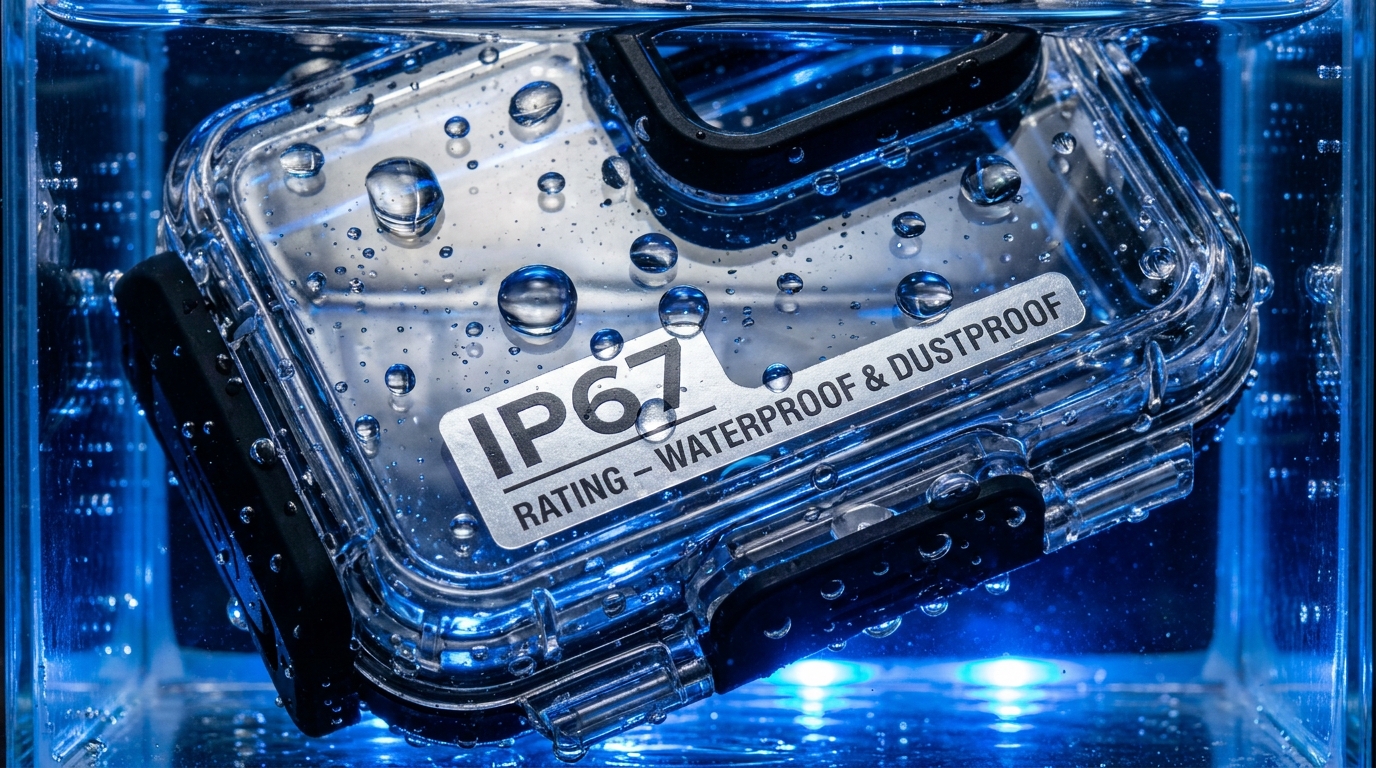
IP67 waterproof case submerged in water tank, IP rating demonstration

If you are evaluating protective cases for industrial, military, or outdoor applications, you have almost certainly encountered the term "IP67." But what does IP67 actually mean, when do you need it, and how do you choose a reliable supplier? This guide, written by the engineering team at KeXinMaterials (Zhongshan Junzhijia) — a source factory with 12 years of experience manufacturing IP67-rated cases for B2B buyers across 50+ countries — walks you through every step of the decision.

By the end of this 2,500+ word guide, you will understand the IEC 60529 standard, the difference between IP67 and MIL-SPEC, the trade-offs between PP, ABS, and PC materials, and the OEM/ODM process for custom IP67 cases. You will also see real factory pricing, lead times, and a checklist you can hand to your procurement team.

Key fact: KeXinMaterials produces 150+ IP67-rated SKUs across 9 product lines — from drone cases to medical cold-chain cases — and ships globally to USA, EU, Japan, and emerging markets.

What Is IP67? The IEC 60529 Standard Explained

The "IP" in IP67 stands for Ingress Protection, a rating system defined by the international standard IEC 60529 (also adopted as EN 60529 in the EU and GB/T 4208 in China). The standard was first published in 1976 by the International Electrotechnical Commission and has been revised multiple times, with the current 2013 edition still in force.

An IP rating always has two digits (or an "X" when a rating is not specified):

So IP67 specifically means: completely dustproof (level 6) AND resistant to temporary water immersion (level 7). It is the most common rating you'll see on B2B protective cases because it strikes a balance between sealing performance, cost, and usability.

It is important to understand that IP67 is not the highest water rating. The progression is:

For most industrial, military, and outdoor applications, IP67 is the sweet spot. IP68 adds cost and weight for marginal real-world benefit unless you specifically need continuous underwater use (e.g., diving equipment housings).

IP67 vs MIL-SPEC: Which Do You Need?

IP67 and MIL-SPEC are not competing standards — they measure different things. IP67 is a single test focused on dust and water ingress. MIL-SPEC (specifically MIL-STD-810) is a family of 30+ environmental tests covering drop, vibration, temperature, humidity, fungus, salt fog, sand, and more.

Here is a practical comparison:

TestIP67MIL-STD-810H
Dust ingress8 hours dust chamberUp to 90 days blowing sand
Water immersion1m / 30 minRain, splash, immersion (variable)
Drop testNot required26 drops from 1.2m on all faces
VibrationNot requiredRandom & sinusoidal, 3 axes
TemperatureNot required-40°C to +70°C operating
Cost impact+15-20% vs basic case+50-100% vs IP67

If your equipment is used outdoors and might get rained on, IP67 is sufficient. If your equipment is used by military, police, fire, or in aerospace, MIL-SPEC is required. Many of our clients specify IP67 + MIL-STD-810 drop as a balanced requirement.

Note that MIL-SPEC cases almost always include IP67 or higher sealing as a baseline. So when evaluating a MIL-SPEC case, ask for the specific IP rating — don't assume.

Materials Comparison: PP, ABS, and PC

The three most common materials for IP67 protective cases are PP (polypropylene), ABS (acrylonitrile butadiene styrene), and PC (polycarbonate). Each has distinct trade-offs.

PP (Polypropylene)

ABS (Acrylonitrile Butadiene Styrene)

PC (Polycarbonate)

Hybrid materials

For the best of all worlds, many premium cases use PP+GF (polypropylene with glass fiber) for the outer shell and a softer TPU seal for the gasket. This is what our Series 8 line uses — achieving IP67 at -40°C to +120°C with a 100kg+ load capacity.

How to Choose: A 7-Point Checklist

Use this checklist when evaluating IP67 case suppliers or specific SKUs:

  1. Real IP67 certificate: Ask for the test report from SGS, TÜV, BV, or CTI. Self-declared "IP67" is meaningless.
  2. Material traceability: Confirm the resin grade (e.g., "SABIC PP 1126" or "ChiMei ABS PA-757"). Generic "engineering plastic" is a red flag.
  3. Gasket integrity: The gasket is the most failure-prone component. Ask about the gasket material (TPU, silicone, EPDM), the groove design, and the compression ratio.
  4. Hinge & latch cycle test: Quality cases survive 10,000+ open/close cycles. Ask for the cycle test report.
  5. Operating temperature range: If you operate in cold or hot environments, confirm the rated range matches your use case (not just storage).
  6. Foam insert compatibility: If you need a custom foam insert, confirm the supplier offers EPE, EVA, PU, or CNC-milled foam. Pre-cut "pick and pluck" is cheapest; CNC is most precise.
  7. OEM/ODM capability: If you need custom color, logo, or tooling, ask for the OEM process, MOQ (typically 300 pcs for custom tooling), and tooling cost (typically $3,000-$8,000 for a new mold).

At KeXinMaterials, every IP67 case we ship is backed by an SGS or CTI test report, full material traceability, and a 1-year warranty against manufacturing defects. Request OEM/ODM quote →

OEM/ODM Process: From Quote to Delivery

Custom IP67 cases follow a 5-step process. KeXinMaterials completes a typical custom order in 30 days from deposit to delivery.

Step 1: Specification (1-3 days)

You provide dimensions, material preference, IP rating, color (RAL/Pantone code), foam insert type, logo artwork, quantity, and target price. We respond with a feasibility review and a preliminary quote within 12 hours.

Step 2: 3D Design & Quotation (3-5 days)

Our engineering team produces a 3D model and 2D drawings. For orders ≥500 pcs, 3D design and tooling cost are free. Tooling cost for new molds: $3,000-$8,000 depending on size and complexity. We issue a formal PI (Proforma Invoice).

Step 3: Sample Production (7-10 days)

We produce a pre-production sample (PPS) for your approval. Sample cost is typically $50-$200 per sample, fully refundable against a confirmed order. Sample shipping via DHL/FedEx 3-5 days.

Step 4: Mass Production (15-25 days)

After sample approval and 30% T/T deposit, we begin mass production. Production lead time depends on order quantity: 15 days for ≤1,000 pcs, 20 days for ≤5,000 pcs, 25 days for ≤10,000 pcs.

Step 5: QC & Shipping (5-7 days)

100% inspection on critical dimensions, IP test on 5% of batch, drop test on 1%. You receive inspection reports and shipping photos. Balance 70% T/T before shipment. Shipping via sea (25-40 days DDP), air (5-7 days), or express (3-5 days).

Total timeline: 30-45 days from deposit to your warehouse, including shipping. Start your OEM inquiry →

Real Pricing: What to Expect in 2026

IP67 case pricing varies significantly by size, material, and order quantity. Below are 2026 reference prices from KeXinMaterials (FOB Shenzhen, USD).

Size categoryInternal dimensions (cm)PP price rangeABS price rangePC price range
Small (S)20 × 15 × 8$8-$14$12-$20$18-$30
Medium (M)35 × 25 × 15$18-$32$26-$45$40-$70
Large (L)50 × 35 × 20$35-$60$50-$85$80-$140
Extra Large (XL)70 × 50 × 30$70-$120$100-$170$160-$260

Volume discounts: 300-1,000 pcs: 10% off. 1,000-5,000 pcs: 20% off. 5,000+ pcs: 30% off + free tooling for orders ≥10,000 pcs.

Hidden costs to watch:

For exact pricing, please request a custom quote via our 5-step OEM form or email kexin@beeaa.com.

Frequently Asked Questions

What is IP67?

IP67 is a rating from the IEC 60529 international standard. 'IP' = Ingress Protection. The '6' means completely dustproof. The '7' means resistant to temporary water immersion (1m depth for up to 30 minutes).

What is the difference between IP67 and IP65?

IP67 can withstand temporary water immersion. IP65 can only withstand low-pressure water jets. IP67 is suitable for outdoor and marine environments; IP65 is sufficient for rain exposure.

Should I choose PP, ABS, or PC for my IP67 case?

PP is lightest, most chemical-resistant, and food-safe. ABS is harder, glossier, and easier to color-match. PC is strongest and most premium but costliest. For most applications, ABS offers the best balance.

What is the MOQ for custom IP67 cases?

At KeXinMaterials, standard SKUs are available from 50-100 pcs. Custom OEM/ODM orders start at 300 pcs.

How long does a custom IP67 case order take?

Sampling: 7-10 days. Mass production: 15-25 days. Sea freight: 25-40 days. Total: 30-45 days from deposit to your warehouse.

How do I get an IP67 test certificate?

Third-party labs like SGS, TÜV, BV, and CTI perform IP testing. Typical cost is $500-$2,000 per test. Turnaround is 7-15 days.

Can IP67 cases float?

Standard IP67 cases do not float. If you need flotation, ask for closed-cell foam inserts or external flotation collars.

What is the warranty on IP67 cases from KeXinMaterials?

1-year warranty against manufacturing defects. Lifetime technical support. Free replacement for any case that fails the IP test within 30 days of receipt.

Need an IP67 Case Quote?

KeXinMaterials source factory, 12 years of IP67 case manufacturing, 150+ SKUs across 9 product lines, exported to 50+ countries. OEM/ODM custom, 30-day delivery.

5-Step OEM Inquiry📧 Email Directly💬 WhatsApp

Related Content

OEM/ODM Case Customization Guide IP67 Protective Case Buying Guide Industry Guides
8 in-depth guides
Case Studies
20 real projects
Entity Graph
8 core concepts
Test Reports
SGS / TÜV / CTI certified